
On Abolition and Restoration
Manual labor, Identity, and Democratic Life

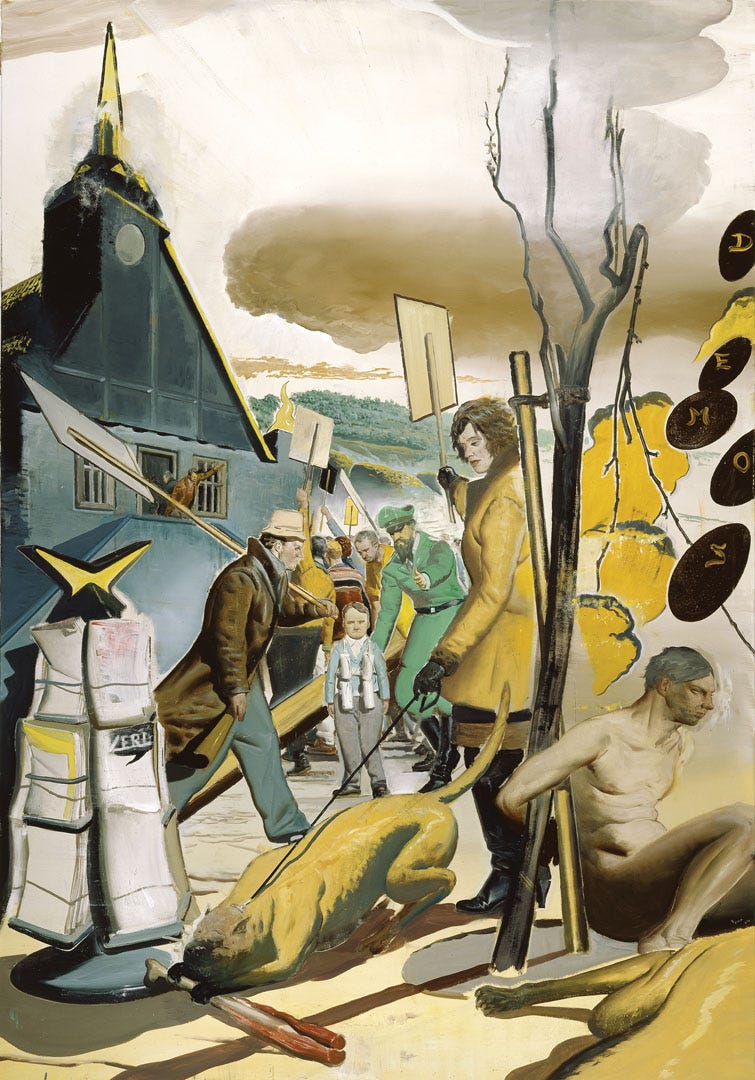
Democracy does not give us our values. Our values give us democracy. This is the great fallacy of our times: we think that democracy and capitalism are the fixed structures in which we live, and are quite confused when they to do not give us a healthy, balanced society.
Since this newsletter started for friends who asked for a broad exposure to art, I’ll begin by introducing you to an artist whom I loved at first sight: Neo Rauch, before I tell you about my new identity (and invisibility) as a manual laborer, and how it has strengthened my understanding that democracy grows from values that we must actively hold.
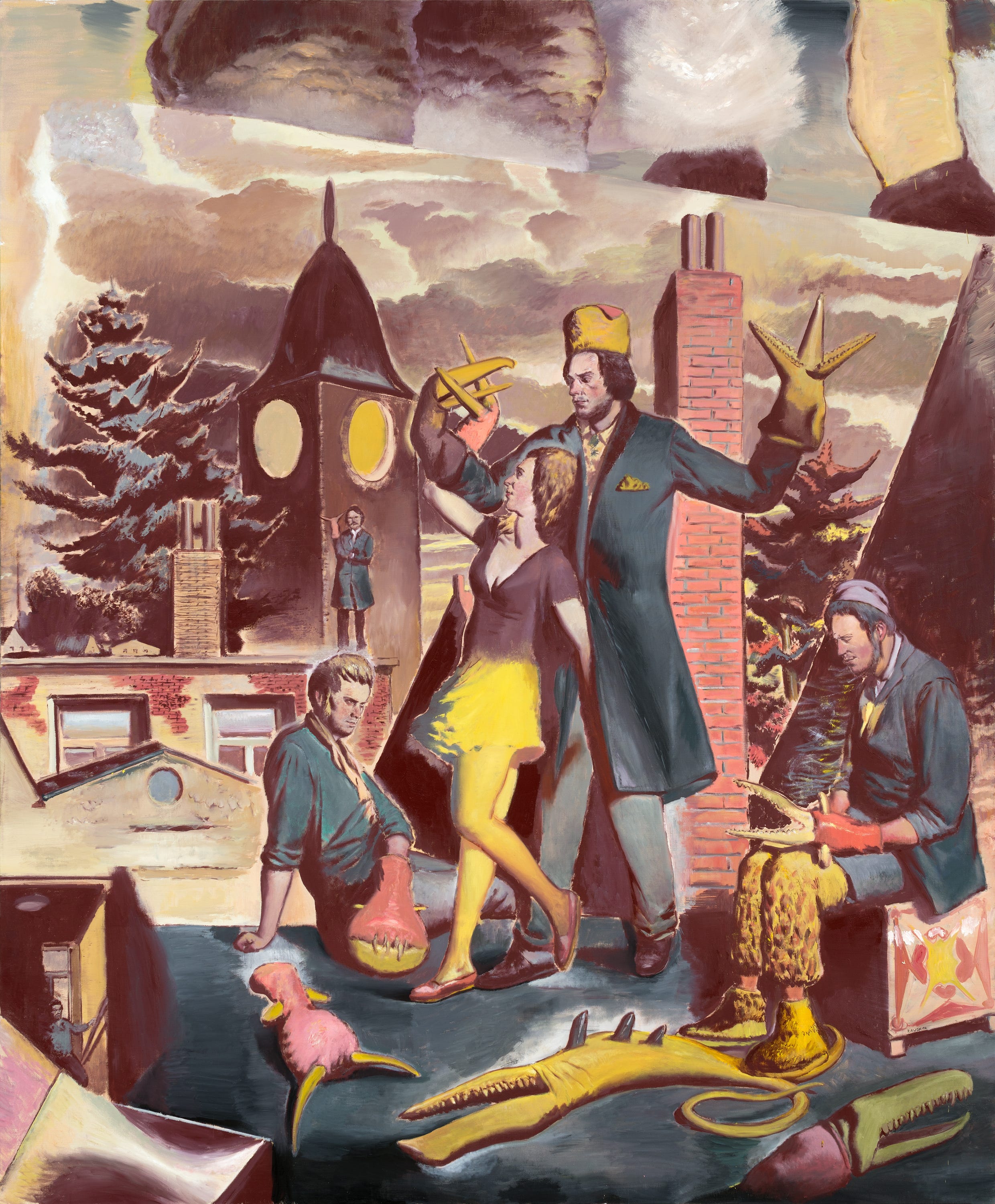
I discovered Rauch’s work some 15 years ago, while visiting a friend in Leipzig, a moody, socialist city, marked by its history of East German industry, and felt at first glance a kindred spirit: a love for the working class, for the mess of life, for the absurdity in it all. To me, his work speaks of the concurrent meaninglessness and also the earnestness of work and life. But he does not wish his work to be interpretable, nor political, so I merely want to introduce his work to you.
Still, even while avoiding political discussions, in a 2023 interview with the NZZ, Rauch pointed out about his Germany: “We are abolishing ourselves as an industrial nation. We take ourselves off the net, and bid farewell to ranks of people who ought to be taken seriously. And we do so with verve, lustful surrender, with religious delight. I standby and watch, stunned and astonished…” (my own translation)
The Germans are not the only ones abolishing themselves and saying goodbye fundamental parts of our societies. We are globally involved in a certain “abolition of man,” in which we are relinquishing our rights and responsibilities.1
I’ve been experiencing one microcosm of the whole: manual labor and how we have become increasingly classist, and how this is affecting the healthy of our democracy.
You see, I have taken work as a manual laborer, working for a low hourly wage, and living with immigrant laborers. The hands are swollen, sore, and the knuckles open from using tools made for the men’s work that it is. There is one other woman on the crew; she’s in her 30s, trained as an art restorer in Portugal, and glad to have found this work here in Switzerland —after first cleaning hotel rooms in a resort.
When one is a laborer, whatever other credentials one might have are rendered irrelevant by the loss of social context. One is, simply, a laborer. As Hannah Arendt explained it, “the biological rhythm of labor unites the group of laborers to the point that each may feel that he is no longer an individual but actually one with all others.”
This grouping might not be forced by others, but how “others” treat the group should be something we are all aware of, if we want to maintain a healthy society.
I was hired to do detailed restoration work on plaster and sgraffito, but arrived to a grand country house that needed the entire facade scraped off, rusted metal gutter holders cleaned, wood stained scraped off window surrounds, etc. There is much to remove first; the detailed plaster and sgraffito work will be a small part of the job. as we prepare and preserve the house for its next 100 years.
This was a surprise, but the bigger shock was how invisible one becomes, as a day laborer:
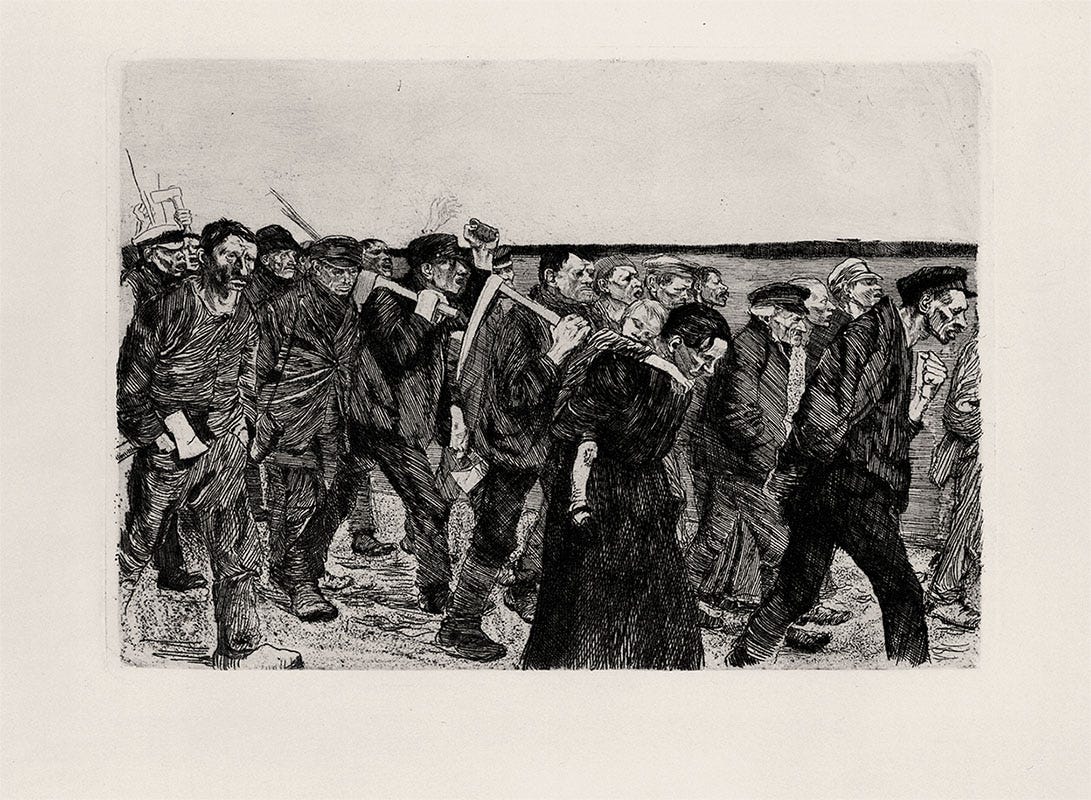
One brief interaction made this clear: the caretaker of the property expressed to two of us, as we studied a section of wall, that the sample wall (for the final color) was too light. I agreed, “yes, it makes it too new,…” and I wanted to add that the scraping off of the plaster had shown us that the original color was a rich burgundy. But I was cut off by the son of the boss —he stepped in front of me and changed the subject. I returned to my section of wall, having understood that I was not to speak. This young 22 year old colleague later came over and said, “you DO NOT speak to the client, you understand? Only my dad does.” I turned and leaned an arm on the scaffolding to look at him, “Young man, I got the message. But let me tell you a few things, and I hope you are listening: I have done many houses, and care deeply about how a renovation goes. I have hired many crews, and as the client (!), I want to know that the lowest worker is engaged. That he thinks about the final product —not mindlessly the small labor he is assigned…”
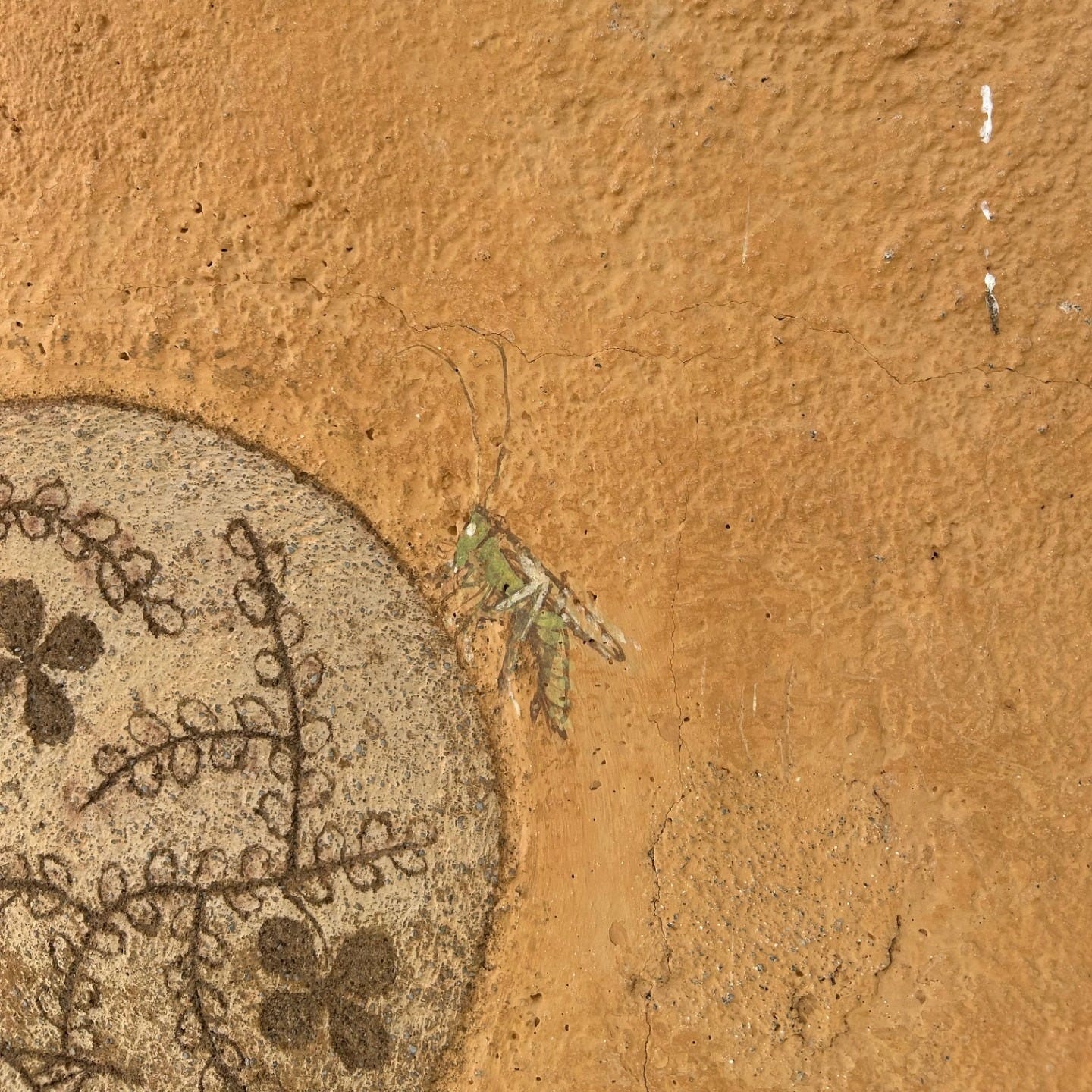
(I understand now why various contractors over the years have expressed surprise and gratitude for how I treat them and their workers on projects: I want to hear their individual opinion, I want to understand their techniques. I also understand now why some workers have said, “Oh, it doesn’t matter what I think,” even when I have asked them. It’s a learned response, where identity is reduced to function. It’s also an abdication of their individual responsibility to the whole, and so it is —to say it dramatically— an abolition of themselves. )
The surprises went on from there. The architect wandered around, wearing his cool jeans and expensive jacket. Dressed just like my architect friends, I observed. He did not so much as glance at us, in our dirty white workwear. No questions about the walls, no observations. “Architects do and know nothing,” one of the other laborers said, when I asked if the architect had indicated how he wanted to fix a water problem on one of the exterior walls, which was causing mold on the interior, and how we should treat the wall. I sighed. Laborers and architect are clearly not in the habit of interacting and both dismiss each other. (This is why I have not used architects on my real estate renovation projects, instead relying on capable laborers who know their craft. Two architects and I are currently writing a book on this subject —stay tuned.)
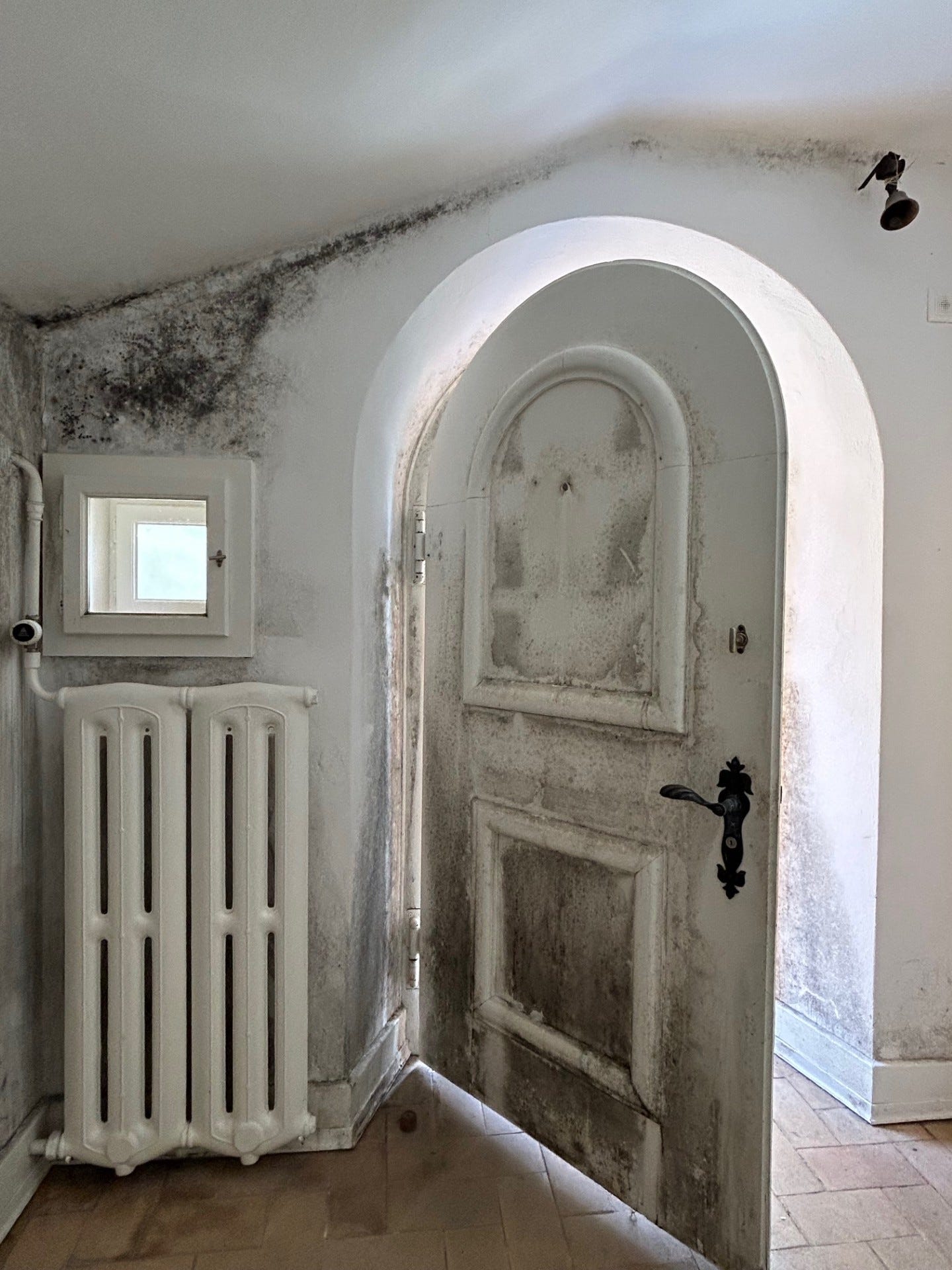
Really, the mold is not a big problem; nor is the breakdown of communication between architect and builders; the actual problem here is another issue entirely. While it is not drastic when hierarchies create communication silos on worksites, the worksite situation is a good example of our larger societal situation.
We see everywhere the lack of understanding between various groups thanks to hierarchical thinking. And it is a problem that democracy is intended to counteract. But democracy itself is not the solution. The solution is the same as that which gives rise to democracy: the collective honoring of each individual’s rights and voice. It is a radical value. And when we truly hold it, we naturally choose democratic means of governing ourselves. Democracy does not give us our values. Our values give us democracy. This is the great fallacy of our times: we think that democracy and capitalism are the fixed structures in which we live, and are quite confused when they to do not give us a healthy, balanced society. What we must remember is that our values and identity determine how we treat one another. And from this emerges —possibly— a functioning democracy and an abundance-bringing capitalism.
Two weeks before I was doing this work in this uniform:
…I hosted a dinner in Zurich, wearing a different “uniform”:
That one is treated differently, based on uniform and context, is undeniable and natural, but we need to guard against it on the larger scale.
The Zurich gathering came together casually, by word of mouth. We discussed the values and identity that underpin Switzerland’s direct democracy, and the internal and external elements that make it “defensible.”2
Democracy is too often assumed to be a fixed structure, when in fact it is a living outcome of certain values. Each culture has its values and identity —some are more similar than others— and some of these have, as a natural conclusion of that culture’s “psyche”— democracy. The Swiss, with their values of individual responsibility, ability, dignity, expectation of excellence, etc., have a solid basis for their direct democracy. I start to wonder how Switzerland can best maintain this, as it takes in more and more foreigners who enjoy the Swiss system, but do not necessarily come with the same values.3 How do we elevate our values, that others might adopt them, too?
We need a society wherein we all —from the philosopher to the laborer— recognize our responsibility, ability, dignity, and treat one another as truly equal. This requires engagement, and such engagement requires effort. A “defensible democracy” is one whose people hold their values, and are willing to contribute —at their own cost— to the whole.4 And if we do not make our small but deliberate effort to participate with one another according to the values that birthed democracy5, we can surely bury democracy as a very romantic notion that had a brief peak in human history, bred mediocrity, and died from general malaise.
Speaking of romance... Lest you think I am romanticizing labor: hardly. Marx and his ilk elevated labor and the result is that we in this post-Marxist world have elevated neither the laborer nor the labor itself; instead we have elevated productivity, and have reduced our value to its metrics.
Also, manual labor is not the highest realm of human endeavor, (perhaps we could said it is necessary, but not sufficient, for man to be engaged in manual labor), but I have no patience for those who have disdain for those performing manual labor. As a society, we are, of course, hellbent on doing away with such labor, aided by machines and AI. The usual argument is a rhetorical question: Why make the human suffer mindless, repetitive, physically straining work, when they can be freed from such discomforts? But what would we do with our freedom? Though Hannah Arendt considered labor the least in the hierarchy of our pursuits (labor, work, and action; for more, read her Vita Activa or The Human Condition), she would argue that labor should only be replaced if by a greater social engagement from each individual: by action and not by consumption.
And on the topic of the various circles and boundaries on which define our identities, I have a book recommendation: Bulgakov’s The Master & Margarita. It’s a wild, strange book, but it’s the one that gave us Mick Jagger singing:
Please allow me to introduce myself
I'm a man of wealth and taste
I've been around for a long, long year
Stole many a man's soul and faith
I was 'round when Jesus Christ
Had his moment of doubt and pain
Made damn sure that Pilate
Washed his hands and sealed his fate
Pleased to meet you
Hope you guess my name
But what's puzzlin' you
Is the nature of my game
Stuck around St. Petersburg
When I saw it was a time for a change
Killed the Tsar and his ministers
Anastasia screamed in vain
I rode a tank…
We certainly do not need the Devil deciding it is “time for a change.” We need to engage ourselves and each other, treating those who are essential but not powerful with the same curiosity and interest as we treat those who are less essential but powerful. We are a messy, insane race, as Neo Rauch’s work hints at, but one that is both collectively and individually worthy of honor and recognition. No sympathy for the devil, but sympathy for each other.
Like in my manual labor — where we must remove many layers to get to the original substance in order to restore the house— in our society, we must remove the structures that have hidden the original substance (values), if we want to restore and preserve democracy for its next 100 years.
I gifted my father a book on Rauch for Christmas 2012. In it I wrote, “Rauch’s work is modern & old, surreal & real, insane & thoughtful.” Sort of like humanity itself.
C.S Lewis’ book Abolition of Man should have been on my suggested list of books to read in the context of our universal submission to machines.
It strikes me now that we did not have any blue collar laborers at the table, though we did have various ages and nationalities around the table.
And, I must ask myself, would the worksite situation have been different, were our team all Swiss, and not Portuguese (apart from myself)? I suspect the dynamic would be different, but my point here is only strengthened, were this the case. Because, regardless of backgrounds, the individual should be perceived, as much as is possible, beyond the group they’re in, if we want to keep a direct and thriving democratic society.
The Swiss require each male to do military or civil service, an excellent way to remind citizens of their mutual sacrifices for the whole.
I will always recommend a focused reading of Tocqueville’s Democracy in America for a very practical examination of democracy, its basic thoughts, and its effects.
Great observations and questions!